
Research & Discovery
Research that uncovers what actually matters - with patients, clinicians, and everyone in between.
Good research doesn't just validate ideas. It reshapes them. It closes the gap between what a team believes to be true and what's actually happening on the ground - in wards, in waiting rooms, in the daily routines that no one thought to ask about. The kind of insight you can't get from a desk or a dataset.
We work directly with the people who'll use, commission, and live with whatever gets built. Not as a box-ticking exercise, but because the difference between a product that gets adopted and one that gets shelved almost always lives in a conversation someone didn't think to have.

Where great ideas meet reality
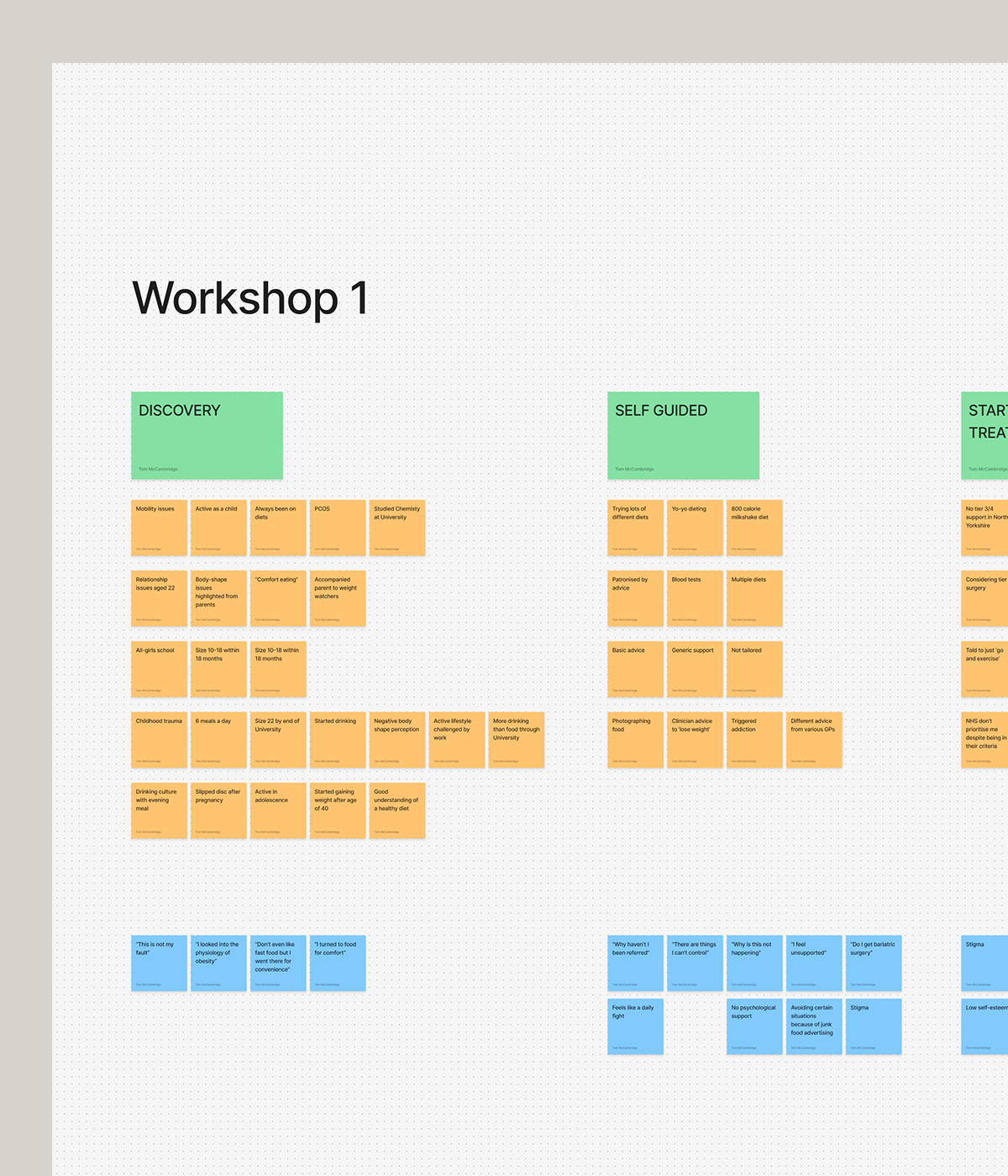
Working directly with people to understand the reality of a condition, a service, or a gap, not what the system thinks the experience is, but what it actually feels like.
Bringing the people who'll use the product into the room where it's shaped. Not at the end for feedback but right at the start, when there's still something to change.
Spending time with the clinicians, nurses, and support staff who'll interact with whatever gets built; understanding the pressures, the shortcuts, and the things that never make it into a specification.
Working out who commissions, who influences, who blocks, and who champions, because in health, the path from idea to adoption is rarely straightforward.
Grounding the work in what's already known - clinical evidence, NICE guidelines, existing research, and the policy landscape that will shape what's possible.
Turning broad insight into focused decisions - what matters most, to whom, and where the work will have the most meaningful impact.
Prototyping a wearable with the people who'd actually use it
The question wasn't just "does this work?" - it was "which version of this works best, and why?"
Starting with industrial design sketches, we explored ergonomics, wearability, and interaction models - how the device would sit on the body, how users would engage with it, and where friction might occur. From there, we developed detailed CAD models for each archetype, refining geometry, button placement, and surface treatment.
Each design was then 3D printed at 1:1 scale using materials selected to approximate the weight and feel of a production device. We incorporated functional elements - tactile buttons, moving parts, and adhesive - so participants could experience something close to reality, not just a static model.
Wearability and comfort - how the device felt on the body across different placements and durations
Interaction and usability - how intuitive each archetype was to operate, from first glance to repeated use
Design perception - emotional response, trust, and willingness to adopt
Supporting materials - packaging, instructions, and onboarding experience
Sessions were structured to capture both behavioural observation and direct feedback, giving the team quantitative comparison across archetypes alongside rich qualitative insight into user needs and concerns.
Most importantly, the team moved into the next phase of development with confidence - knowing the direction they'd chosen was grounded in how people actually responded, not how stakeholders imagined they would.
Let's Talk
Got something in mind? Let's talk it through.